


 Release time:2023-07-23
 Number of views:1340order
First, diamond drill preparation:
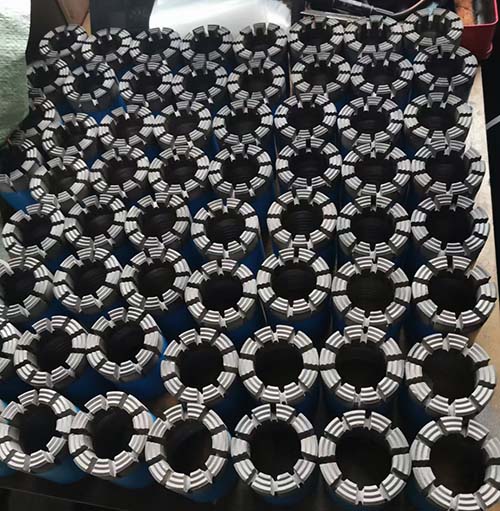
1. Check whether the last diamond bit has any damage to the bit body, tooth loss, etc., to ensure that the bottom of the well is clean and there is no falling object.
2. Carefully transport the diamond bit and place it on a rubber pad or wooden board.
3. Check whether there is damage to the cutting teeth of the diamond bit and whether there is foreign matter in the diamond bit.
Second, diamond drill button:
1. Clean the male or female diamond drill bit and apply thread oil.
2. Clamp the shackle on the diamond bit and lower the drill string so that it contacts the male or female buckle.
3. Insert the diamond bit and shackle into the turntable, and then tighten the buckle according to the recommended winding torque value.
4. When loading and unloading drill bits and reamer, do not use tool clamps or clips to hit the diamond body violently, so as to avoid the body breaking off and causing accidents in the hole.
Third, drilling:
1. Lower the diamond bit slowly to protect the cutting teeth.
2. Pay attention to the obstructed well section that occurred during the last drilling. If the diameter reduction and dog leg are encountered during the drilling process, make the bit pass slowly.
3. About 1 single pipe from the bottom of the hole, start to rotate at the drilling rate of 50-60rpm and open the pump with a rated displacement to flush the bottom of the hole.
4. Pay attention to the weight indicator and torque to make the diamond bit touch the bottom of the hole smoothly.
Four, diamond bit modeling:
1. Keep the rated displacement and lower the diamond bit to the bottom of the hole.
2. Use slow drilling of at least 1m to build a bottom hole model.
3. Increase the bit weight to the optimal value of normal drilling with each increase of 10ZN, and prohibit excessive pressure, resulting in early damage to the diamond bit.
4. Maintain constant weight on bit and adjust drilling rate to get the best combination of drilling parameters.
Five, diamond drill normal drilling:
1. When encountering abrasive or hard sand mudstone, reduce drilling rate to extend the life of diamond bit.
2 Adjust the drilling rate or diamond bit to maintain optimal drilling performance when encountering formation changes or intercalations.
3. Pay attention to the following points when each connection is made: (1) restore the pump stroke and check the riser pressure (2) Start the pump before the diamond bit touches the bottom hole, slowly lower the diamond bit to the bottom hole at the drilling rate of 50-60rpm (3) Slowly restore the pressure to the original diamond bit, and then increase the drilling rate to the rough drilling rate.
Warm reminder:
Field use has proved that the diamond bit has the advantages of fast speed, more footage, long life, stable work, less accidents in the hole and good drilling quality. But at the same time, it is still necessary for users to use in strict accordance with the above requirements in order to achieve good use results.