 Release time:2023-07-23
 Number of views:1567order
The hole accident is a common event in the geological exploration industry. Hole collapse drilling and drilling clamping are also the most common types of hole accidents, which will bring immeasurable losses to geological exploration, survey target tasks and drilling construction teams.
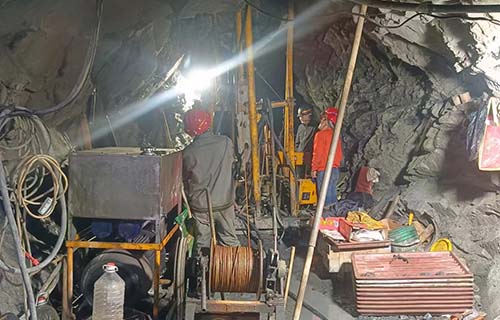
The occurrence of accidents is influenced by geological factors, such as mud belts, uncertain broken blocks, etc., but usually can be pre-judged, and requires a lot of experience of drillers, at least not to cause irreversible, abandoned holes.
When clamping the drill, the operator's first thought is to let the rig clamp the drill pipe forward and reverse the activity to see if the drill pipe can turn up, or through the forward and backward of the drill head to see if it can be pulled out. In the encounter of clamp drilling, I do not object to everyone using this method to try, pull out, turn, stop in time, to fully consider whether the thread strength of the drill pipe thread, reamer, caliper is able to withstand such impact load, repeated operations will increase the risk of accidents in the hole become worse.
When clamping drilling, first of all, the internal pipe system should be lifted out, in the extraction of drill pipe, if the rig can not move, turn, then directly on the professional tool, that is, the extractor. The static load is constantly used to overcome the force in the hole, the pressure is drawn out, the force is held in the stage, the event is maintained for a period of time, and then the force is continued to increase to avoid the use of large impact load force. At this time, if it is pulled out, we can use the salvage tool to salvage. Back to the beginning, if the inner pipe system is not lifted out and directly twisted or pulled out, a thread breaks from the gauge, and the spearhead of the snapper assembly is exposed, this situation cannot be salvageable, and the hole should be disposed of, and more energy and time will be spent on new work.
Especially when the hole is played at a large Angle, we should pay attention to the wear of the outside diameter of the reamer and the caliper, and prevent the clamp from being stuck due to the hole shrinking and the high-speed fall of the drill pipe after the replacement of the reamer. If the water joint also falls into the hole, the treatment is very troublesome, and there is also the risk of waste holes. It is difficult to wear off the water joint with a diamond bit, and the bearing of the water joint will follow the drill when it is worn to the bearing part, which is not easy to wear.
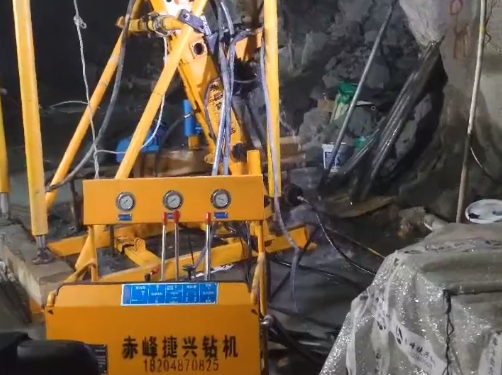
Therefore, in the process of drilling, it is necessary to observe the three pressure gauges frequently, and judge the situation in the hole in time to avoid accidents.